Is your feature request related to a problem? Please describe.
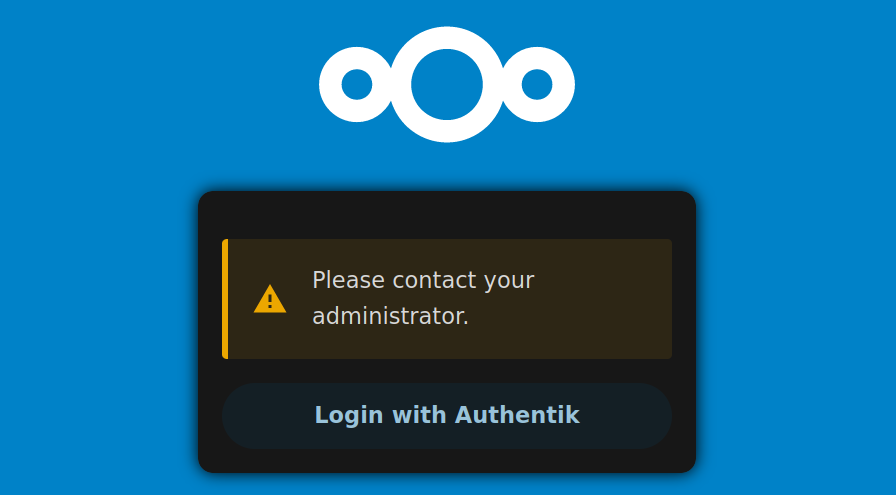
Since #25910 it's possible to disable the native login form. This is a greate feature if you solely rely on SSO to login as users are less confused where to enter their credentials. The problem for me is that the current error message that replaces the form is puzzling for a user as it says: "Please contact your administrator." This is disruptive as the form not being there is expected and there is no reason to contact a system administrator if SSO works as expected.
Describe the solution you'd like
Disable the notecard altogether: As the setting is turned on by the admin there will be a reason behind this (SSO is the only one I can think of) and it is to be assumed that there is no information to the user or action from the user needed.
Describe alternatives you've considered
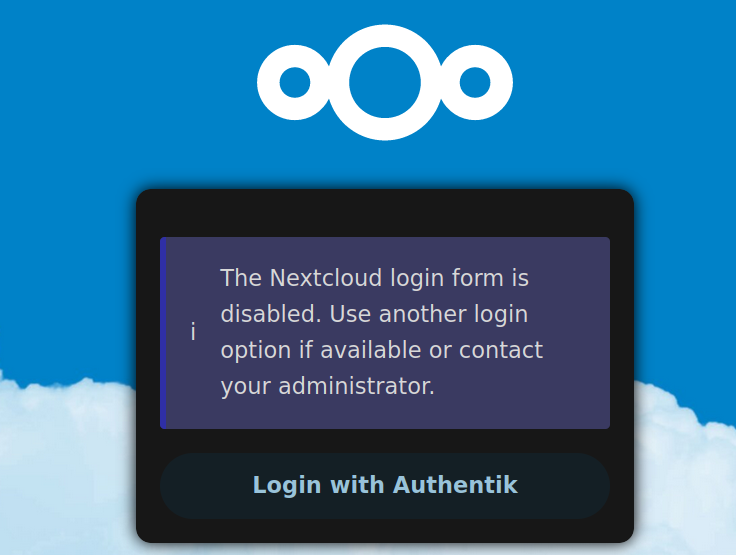
Replace the text and re-style the notecard so that it does not show a warning. It could use notecard--success or implement something new like notecard--info
This is a trough sketch how it could look like
Additional context
This issue is also outlined here: https://blog.cubieserver.de/2022/complete-guide-to-nextcloud-oidc-authentication-with-authentik/
Is your feature request related to a problem? Please describe.
Since #25910 it's possible to disable the native login form. This is a greate feature if you solely rely on SSO to login as users are less confused where to enter their credentials. The problem for me is that the current error message that replaces the form is puzzling for a user as it says: "Please contact your administrator." This is disruptive as the form not being there is expected and there is no reason to contact a system administrator if SSO works as expected.
Describe the solution you'd like
Disable the notecard altogether: As the setting is turned on by the admin there will be a reason behind this (SSO is the only one I can think of) and it is to be assumed that there is no information to the user or action from the user needed.
Describe alternatives you've considered
Replace the text and re-style the notecard so that it does not show a warning. It could use
notecard--successor implement something new likenotecard--infoThis is a trough sketch how it could look like
Additional context
This issue is also outlined here: https://blog.cubieserver.de/2022/complete-guide-to-nextcloud-oidc-authentication-with-authentik/